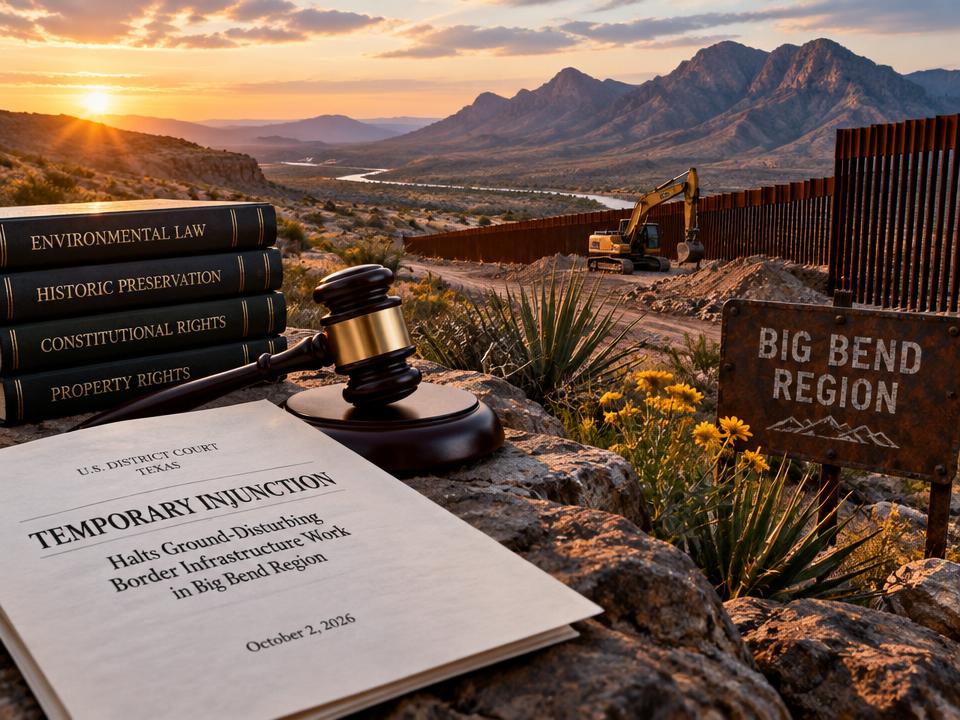
The bulldozers have been stopped, but the larger fight is just beginning. A federal judge’s October 2, 2026, order halting border construction in Texas’ Big Bend region puts a powerful federal waiver authority under a constitutional spotlight: can the government set aside laws to build quickly and still avoid judicial review of how that power affects landowners and protected places?
U.S. District Judge Kathleen Cardone issued a preliminary injunction barring ground-disturbing work while the lawsuit proceeds. She found the plaintiffs likely to succeed on their constitutional claims and likely to suffer serious, irreparable harm without an injunction. She also concluded that the balance of equities and the public interest favored pausing the work. That is an interim decision, not a final ruling that the project is unlawful—and it applies to Big Bend, not the entire national border-construction program.
The case was brought by the Center for Biological Diversity on behalf of Friends of the Ruidosa Church, a nonprofit seeking to preserve a historic church, and Danny William Miller, a river guide and landowner whose property could be taken for the project. The challenge concerns five contracted projects, including work in and around Big Bend National Park. The lawsuit argues that the administration exceeded constitutional limits, including by violating separation-of-powers principles and depriving people of their land.
The legal pressure point is a 1996 border statute. It gives the Homeland Security secretary authority to waive legal requirements the secretary determines necessary to speed construction of border barriers and roads. In May, DHS invoked that authority for the Big Bend project and waived laws covering environmental review, endangered species, water pollution and historic preservation. That move made it harder to stop the project simply by arguing that those laws were not followed. The new ruling shows why the challengers’ constitutional and property claims matter: a statutory waiver does not automatically settle whether the government’s use of that power is lawful.
The scale makes the dispute more than a local fight. The administration’s broader border effort is part of a $46 billion program involving steel barriers, vehicle barriers, roads and surveillance equipment. In the Big Bend sector, the Texas Tribune reported, the region spans about a quarter of the border but accounts for roughly 1% to 3% of annual migrant apprehensions. The government, by contrast, says infrastructure is necessary to achieve operational control and points to more than 89,000 apprehensions in the sector from fiscal years 2021 through 2025. Those figures frame competing judgments about need; they do not decide the legal questions before the court.
Property rights are another immediate stake. The government has sought landowner permission for construction and surveys, and has said it could refer some cases to the Justice Department when permission was not obtained. For residents, the threat is concrete: a barrier, road or restricted river access can change how a person uses land or earns a living. For the government, pausing a large construction plan carries its own security and operational costs. The injunction temporarily keeps both consequences from becoming irreversible while the court examines the claims.
The takeaway is not that border infrastructure has been permanently rejected. It is that fast-track authority may face a harder test when construction reaches private land and sensitive public places. The case will now probe where congressional delegation ends, what constitutional protections remain, and whether the alleged harm justifies blocking work before a final judgment. For other agencies relying on broad waiver powers, the result could clarify how much those powers insulate government action from court review.