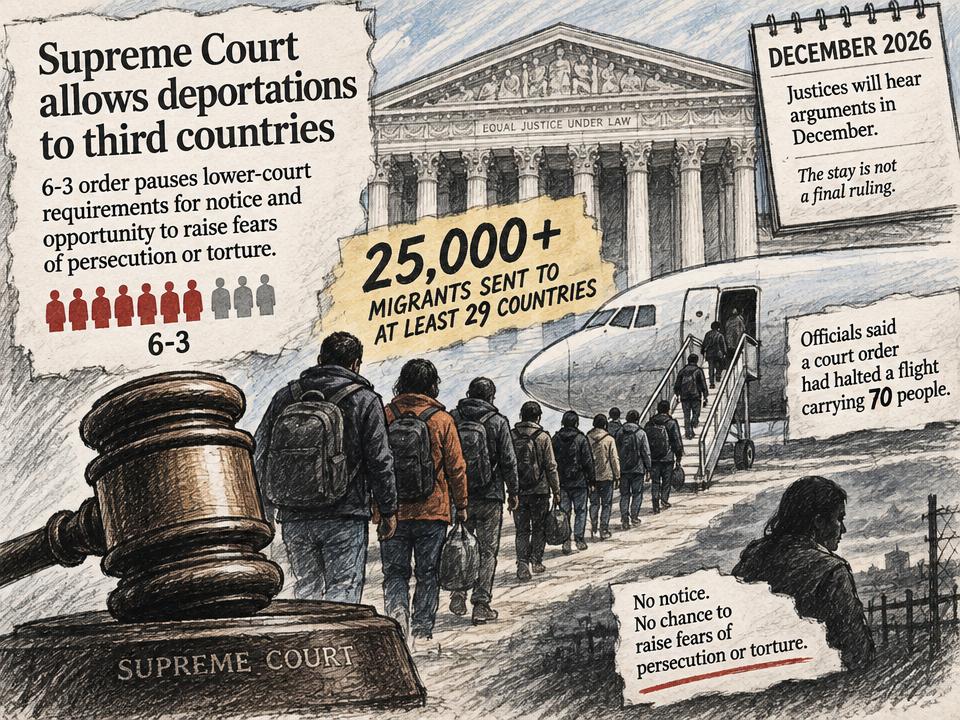
The Supreme Court on September 29 let the Trump administration resume deporting migrants to countries other than their own while the justices review whether the policy is lawful. The 6-3 emergency order temporarily lifted lower-court protections requiring notice and a meaningful chance to raise fears of persecution or torture before removal.
The dispute centers on migrants whose deportation orders name one country but who are instead sent elsewhere. A federal judge in Massachusetts ruled in February that the administration’s process was unlawful; the 1st U.S. Circuit Court of Appeals upheld most of that ruling on September 18. The administration then asked the Supreme Court to put the lower-court protections on hold.
The scale is substantial: More than 25,000 migrants have been sent to at least 29 countries under the policy, according to figures cited by news organizations. The administration said the lower-court order forced it to cancel a flight carrying about 70 people bound for three countries. The Supreme Court’s order allows removals to resume for now, but does not decide the policy’s ultimate legality.
The administration argues that destination countries’ assurances against torture and persecution are enough, and that added hearings can disrupt removals and diplomatic arrangements. Lawyers for migrants say people need notice and a real opportunity to explain why a particular destination may put them in danger. The lower-court protections addressed that individual review; the Supreme Court’s stay pauses them while the case proceeds.
Justices Sonia Sotomayor, Elena Kagan and Ketanji Brown Jackson would have left the protections in place. The full court is set to hear arguments in December on the case, including the policy’s legality and lower courts’ authority to hear the challenge. Until then, the practical question is whether migrants can be removed before they have a meaningful chance to raise safety concerns.