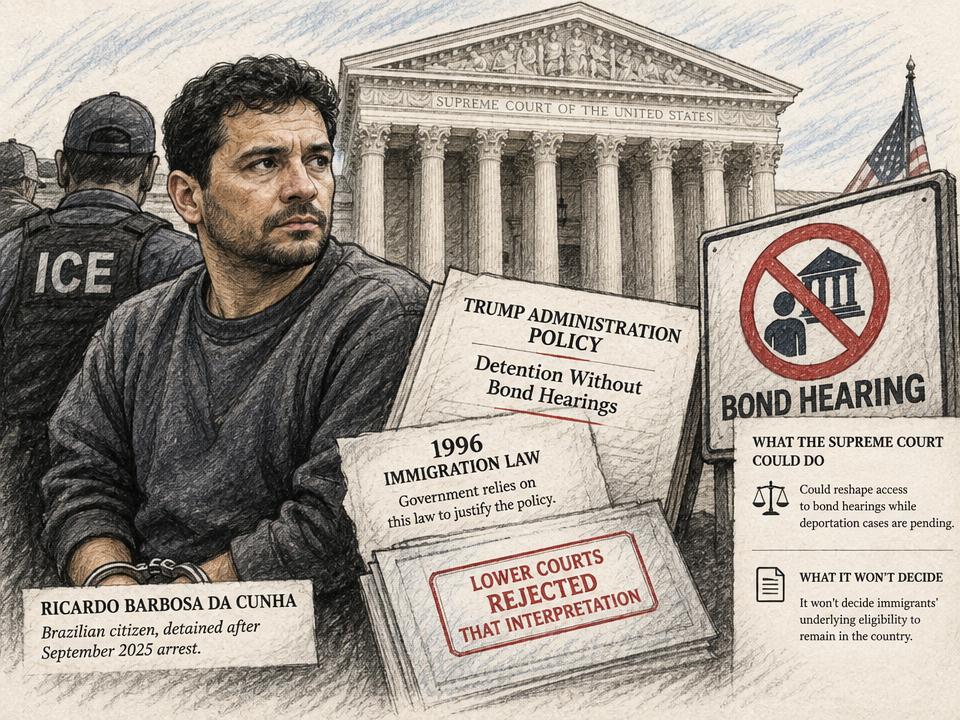
The Supreme Court will decide whether the Trump administration can keep immigrants arrested inside the United States locked up during deportation proceedings without giving them a chance to seek release on bond. The justices agreed on October 1, 2026, to review a policy with consequences for millions of people and a central role in the administration’s deportation drive.
The case, Rhoney v. Barbosa da Cunha, centers on Ricardo Aparecido Barbosa da Cunha, a Brazilian citizen arrested in September 2025. An immigration judge deemed his detention mandatory, denying him a bond hearing. Barbosa da Cunha challenged that decision, arguing that federal law allows people in his circumstances to seek release while their cases proceed.
The administration says a 1996 immigration law requires detention without bond for people it considers applicants for admission. Its guidance, issued in July 2025, applied that reading to immigrants already living in the country who were arrested away from the border. Their removal cases can take months or years, leaving detention potentially prolonged while the cases are pending.
Lower courts have sharply challenged the government’s interpretation. Nine of the 11 federal appeals courts to address the policy have ruled against it, according to reporting on the dispute. The Second Circuit, which ruled in Barbosa da Cunha’s case, said a separate part of immigration law governs people like him and permits bond hearings.
The justices have not ruled on whether the policy is lawful. Their decision will turn on how the statute applies to immigrants present in the United States without having been admitted. It will not itself determine whether Barbosa da Cunha—or other detainees—can remain in the country. But a ruling for the administration could remove a key route to bond hearings; a ruling against it could limit the government’s ability to hold people without individualized review while deportation cases move forward.