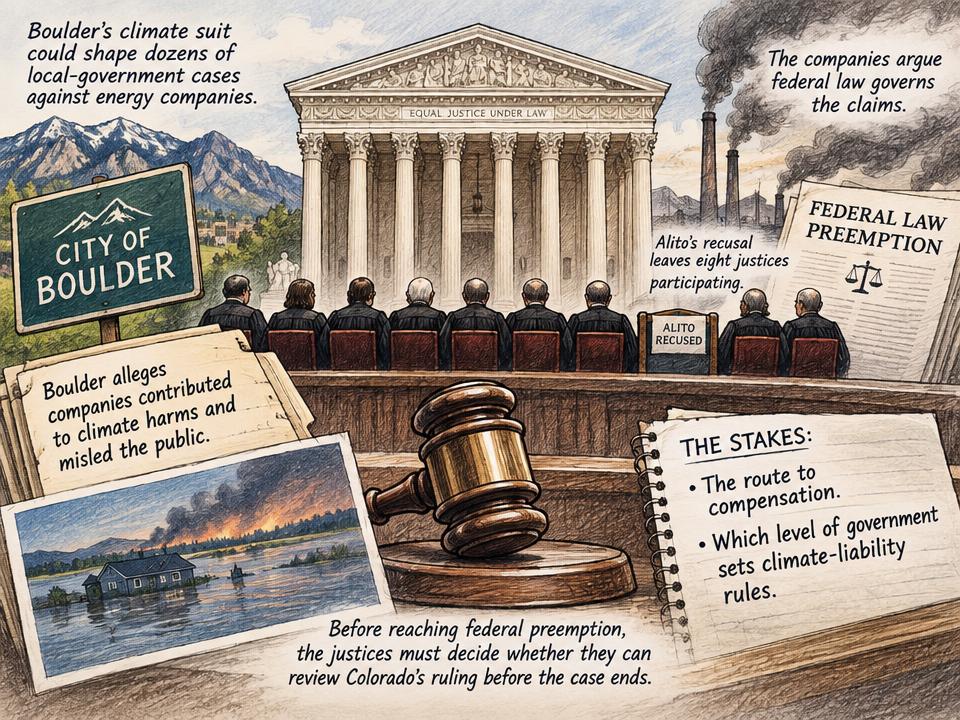
The pattern behind the Supreme Court’s climate case is bigger than climate policy: before deciding who may be liable, the justices may have to decide whether they can hear the dispute at all. That threshold question could shape the fate of lawsuits filed by cities and states against energy companies nationwide.
On Monday, October 5, the Court is scheduled to hear arguments in a case brought by the City of Boulder and Boulder County against ExxonMobil and Suncor Energy. Filed in 2018, the Colorado lawsuit alleges the companies’ fossil-fuel activities contributed to climate-related harms and that they misled the public about climate risks. The local governments seek to use state law to pursue compensation; no court has ruled that the companies are liable.
The companies’ central argument is that claims based on global greenhouse-gas emissions belong under federal law, not Colorado tort law. They point to the Constitution, the Clean Air Act and federal authority over interstate and international matters. Boulder’s position is that state courts can hear claims for local injuries without setting national emissions rules. That distinction—compensation for alleged harm versus regulation of emissions—is at the heart of the fight.
But the justices may first face a procedural gate. Colorado’s Supreme Court rejected the companies’ federal-preemption defense and sent the case back to the trial court. It did not decide whether the allegations are true, whether the companies owe damages or how much. The U.S. Supreme Court has asked whether it has authority to review that state-court ruling now, before the underlying lawsuit has reached a final judgment.
That question matters because a decision about when the Supreme Court can step in may affect other cases, even if the justices do not resolve the climate-law dispute. If the Court reaches the merits, its ruling could influence dozens of similar state and local lawsuits, some still moving through courts and others already dismissed. The Court could also decide the case narrowly, leaving major arguments about federal authority for another day.
- The companies say state-by-state liability claims risk using local law to govern emissions with national and global effects.
- Boulder says it is seeking relief for alleged local harms, not asking a Colorado court to write a nationwide emissions code.
- The pending case concerns whether the claims can proceed—not a final finding of misconduct or an award of money.
One further signal: Justice Samuel Alito has recused himself. He holds investments in oil and gas companies, though not ExxonMobil or Suncor, according to reporting on his decision. Eight justices are therefore expected to participate. His absence does not determine the result, but it underscores how a procedural case about corporate exposure can also place the Court’s own rules and institutional choices in view.
The practical takeaway is not that Boulder has won, or that energy companies have been cleared. The trial has not resolved liability. The immediate question is who gets to hear the claims and under what law. For taxpayers facing climate-related costs, companies confronting litigation, and other local governments weighing similar suits, the Court’s first answer may be as important as its eventual answer on federal preemption.