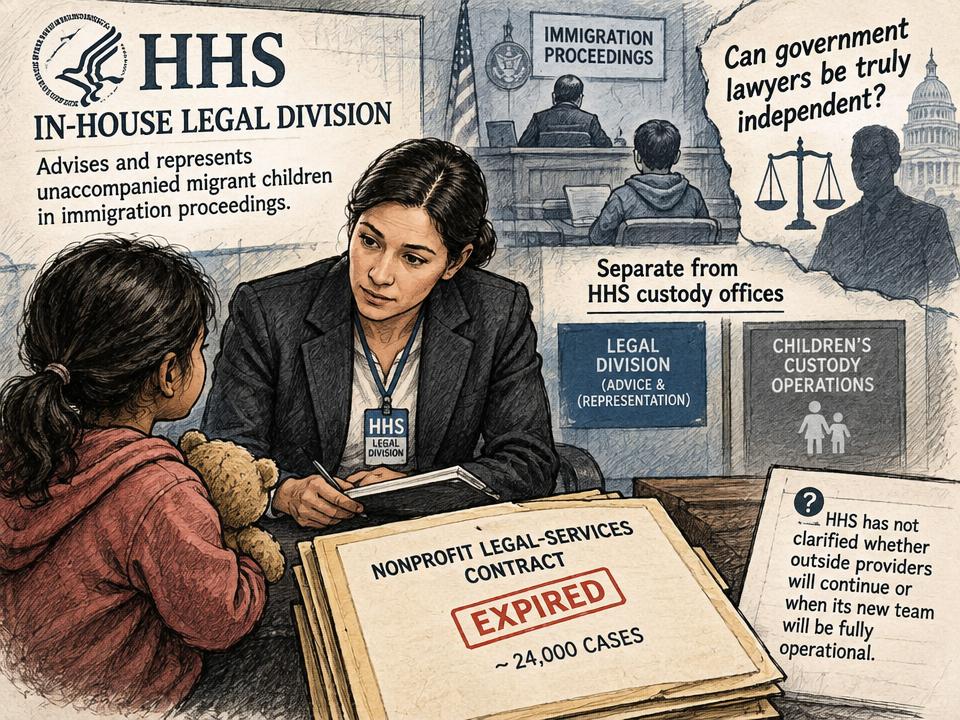
The lawyers advising unaccompanied migrant children in immigration court will now work for the federal agency that oversees their care. A September 29 federal notice establishes an in-house Health and Human Services legal division, setting up a consequential shift in who may defend children facing deportation.
The new division can give children legal advice, explain immigration proceedings and their rights, and represent them before immigration courts. HHS says it will operate separately from the department’s Office of Refugee Resettlement, which handles children’s custody and care. The notice also says its lawyers may not advise or represent those HHS offices in matters where they represent a child.
That separation is central to the dispute. Advocates warn that government-employed lawyers may not be independent when their clients’ cases challenge the same administration that holds the children in federal custody. HHS says the division will provide legal support and help reunite children with family. The notice does not say whether outside legal-service providers will continue to receive contracts, or when the new team will be fully operational.
The change follows upheaval in the existing system. A federal contract supporting a network of nonprofit legal providers expired July 31; that network had managed about 24,000 children’s cases. HHS later arranged temporary representation for children in its care through the U.S. Committee for Refugees and Immigrants through December 31, while some providers continued working despite funding disruptions. Those details mean the new division’s creation does not establish that all children are currently without lawyers—or that every child will be represented by an HHS attorney.
Federal law directs HHS, “to the greatest extent practicable,” to ensure eligible unaccompanied children have counsel in legal proceedings. The immediate test is whether the agency’s new lawyers can provide effective advocacy while meeting that duty—and how the department will handle conflicts between a child’s interests and its own. No court ruling on the new division was reported in the cited coverage.