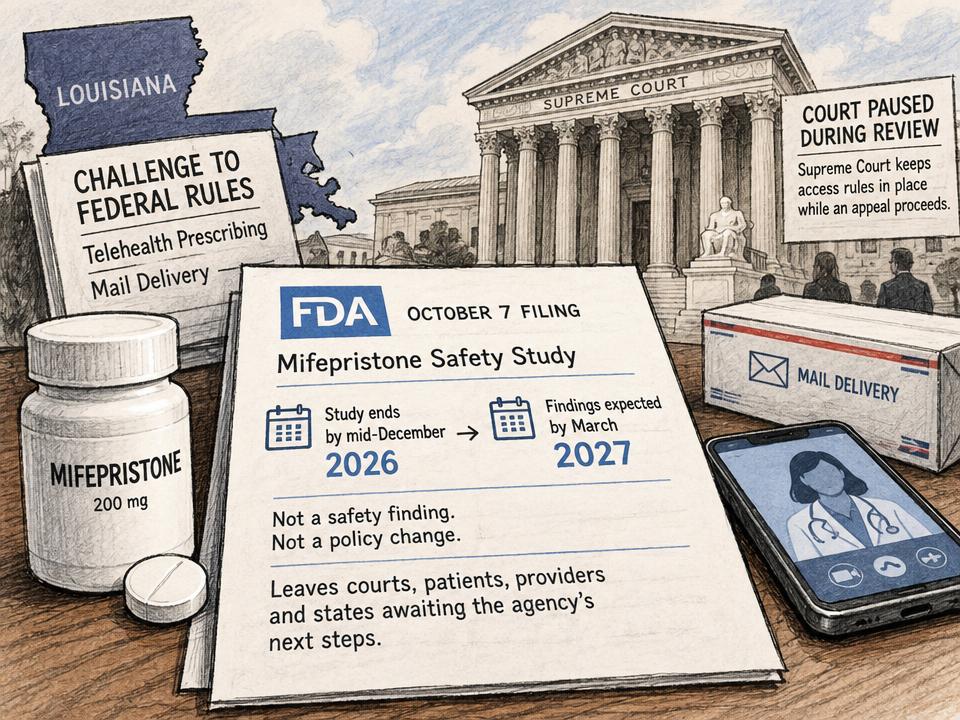
Mifepristone’s legal fight now runs on two clocks: an FDA review expected to produce findings by March 2027 and a lawsuit seeking to restore in-person dispensing. An October 7 filing clarifies when the agency expects to act, but it does not change the rules patients face today.
The FDA told a federal court its safety study should be complete by mid-December 2026, with a report on findings due no later than March 2027. Afterward, the agency says it will decide whether to impose new restrictions or make other changes. The filing was required by a Louisiana judge overseeing a challenge to mail-order access. A progress-report deadline is not an order to change policy, and a review timetable is not a safety finding.
Louisiana’s suit challenges the FDA’s 2023 change to mifepristone’s risk-management rules under the Administrative Procedure Act. The change removed the in-person dispensing requirement and allowed certified prescribers and pharmacies to send the drug by mail. Louisiana argues the FDA acted arbitrarily or contrary to law. The practical relief the state seeks could restore in-person dispensing, affecting how the drug is obtained beyond Louisiana.
The procedural path explains why the latest filing matters. In April, the district judge denied Louisiana’s request to suspend the rules and paused the case so the FDA could conduct its review, while warning that unreasonable delay could change his assessment. The Fifth Circuit later questioned whether Louisiana has standing to challenge the federal rules and whether its claims justify relief. The appeals court’s interim order would have suspended the 2023 rule, but the Supreme Court stayed that order in May. As of October 8, mail and telehealth access under current federal rules remain available; neither the filing nor a final appellate judgment has changed them.
The deeper issue is who evaluates drug safety—and what courts can do when a state says a federal agency exceeded its authority. The FDA says it is using statistical data mining of electronic records from health networks and insurers to look for safety signals. That process is a search for patterns, not a finding that the drug is unsafe. In an Administrative Procedure Act case, judges assess whether the agency followed the law and explained its choices; they do not simply replace the FDA’s scientific judgment with their own.
The consequences reach beyond one state. A nationwide rollback could affect providers and patients in states where abortion remains legal, as well as people crossing state lines for care. The lawsuit therefore tests whether one state can use a federal case to challenge national drug-distribution rules based on alleged effects of care delivered across borders.
The arguments cut both ways. Louisiana says mail delivery undermines enforcement of its abortion ban and that the FDA’s regulatory decision failed legal standards. Supporters of access warn that restoring in-person dispensing would create a practical barrier, including in states that permit abortion. The agency’s review adds a separate question: whether its eventual findings support changing the rules, regardless of what the courts decide about the lawsuit.
The immediate takeaway is narrower than either side’s victory claim. The October filing neither establishes a new safety problem nor announces new restrictions. It sets a timetable while the legal challenge continues and current mail-access rules remain in place. The next major shift may come from the FDA’s findings, a later court ruling, or both.