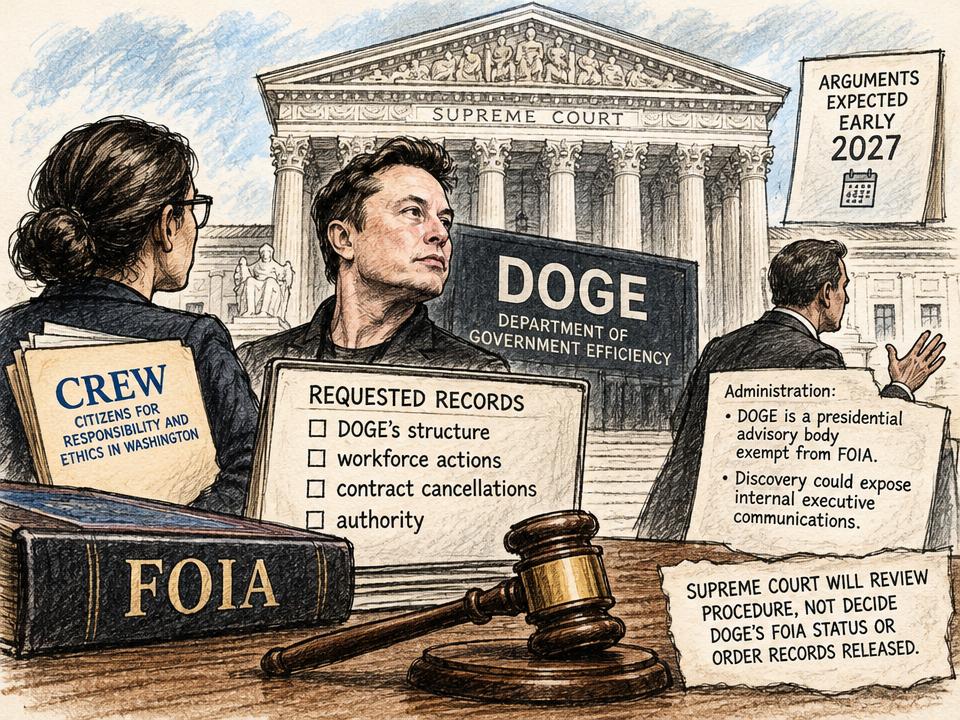
The Supreme Court agreed on October 13 to hear a dispute over whether courts may let watchdogs probe presidential advisers before deciding if those offices must disclose records under federal transparency law. The case puts Elon Musk’s Department of Government Efficiency at the center of a question with consequences beyond DOGE: how much discovery a requester can use to test whether the Freedom of Information Act applies.
Citizens for Responsibility and Ethics in Washington sued after the government declined to process its 2025 FOIA request. CREW sought material including DOGE’s organizational chart and financial disclosures, and later narrowed its requests to records about DOGE’s structure, its directions to cancel contracts and fire workers, and examples of independent authority, including access to sensitive systems. A district judge allowed limited discovery and a deposition of acting administrator Amy Gleason.
The administration says DOGE was an advisory body inside the Executive Office of the President, not a FOIA-covered agency. It argues the discovery order intrudes on presidential advisers’ confidentiality and could reveal the very information the lawsuit seeks before the court decides whether the law covers DOGE. CREW argues the records are needed to establish how much independent power DOGE wielded.
That procedural sequence is the case’s core. The justices are not yet deciding whether DOGE is an agency under FOIA or ordering any records released. They will review whether lower courts exceeded an earlier Supreme Court instruction to narrow discovery, and whether broad discovery may be used to determine if FOIA applies at all.
That line could affect future cases involving presidential advisers and other disputed entities: if courts limit fact-finding at the threshold, requesters may have less ability to establish that an office is subject to disclosure; if discovery can proceed, the government may face broader litigation into executive operations. The Court is expected to hear arguments in early 2027 and rule by the end of June. Until then, DOGE’s FOIA status remains unresolved.