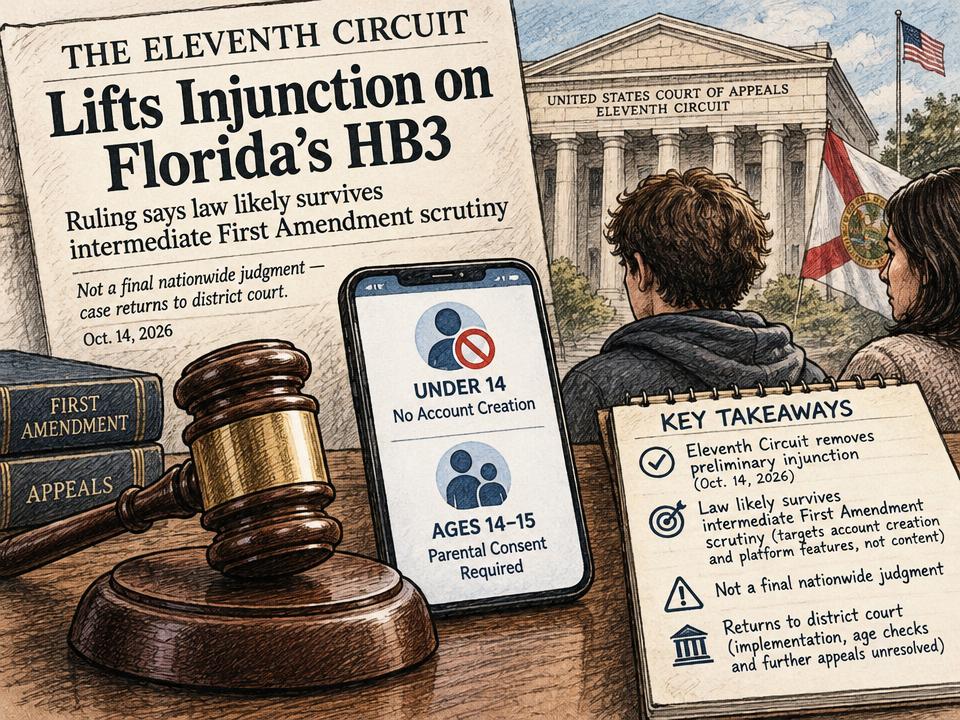
A federal appeals court has moved the legal line over children’s social media from what platforms say to how they are built. On October 14, 2026, a unanimous three-judge Eleventh Circuit panel cleared Florida to enforce HB3, its 2024 restrictions on minors’ accounts. The ruling is a major First Amendment win for the state, but it is not a final nationwide judgment.
HB3 bars children under 14 from opening accounts on platforms meeting a detailed test; 14- and 15-year-olds need parental permission. A service is covered if at least 10% of its daily active users under 16 spend an average of two hours a day on it, it uses recommendation algorithms, and it has at least one listed feature: infinite scrolling, push notifications, visible engagement metrics, autoplay or livestreaming. The law focuses on features, not a specific subject or viewpoint.
That design choice is the constitutional hinge. The Eleventh Circuit said the law does implicate protected expression, rejecting any suggestion that online speech disappears from First Amendment review. But the panel treated HB3 as content-neutral: it regulates platform functions and account creation, not messages, topics or viewpoints. That classification matters because the court applied intermediate scrutiny, a less demanding test than strict scrutiny.
Under that test, Florida had to show an important government interest and a fit between that interest and the speech burden—not prove HB3 is the least restrictive imaginable option. The panel accepted child protection from social-media addiction as the important interest and stressed the law’s limits: it targets a subset of minors, a subset of platforms, and account creation rather than all access. It held the trade groups had not shown HB3 likely fails that test as applied to their members.
Those distinctions offer the state a path around the most powerful objection: that parents and young users use social apps to find information, share ideas and participate in public life. Florida’s position is that a restriction tied to usage patterns and interface design is not censorship of any idea. The court accepted that distinction at this stage. It did not decide the broader policy question of whether the statute will actually improve young people’s mental health.
The decision also exposes costs beyond litigation. Platforms may need to determine which users are minors and, for teens, whether a parent consented. NetChoice warned that compliance could require age- and parent-verification systems affecting users broadly; the appellate ruling did not settle what an adequate system must look like or resolve the privacy risks of collecting age-related data. That practical burden may now shift from hypothetical threat to active compliance planning.
The procedural posture still matters. The district court had issued a preliminary injunction in 2025; the appeals court had stayed that order while the appeal proceeded, so HB3 could already be enforced during the appellate process. On October 14, the panel reversed the injunction on the as-applied challenge, vacated it on the facial challenge, and sent the case back to district court. The fight is not over, and further review remains possible.
The ruling binds courts in the Eleventh Circuit, not the whole country. But its reasoning will matter in similar fights: lawmakers may try to regulate design mechanics and age-gated accounts rather than content, while challengers will argue that restricting access still burdens protected speech. The takeaway for families and companies is immediate: Florida’s rules are enforceable now, but the constitutional boundary—and the privacy cost of checking age—remains contested.