Case Overview
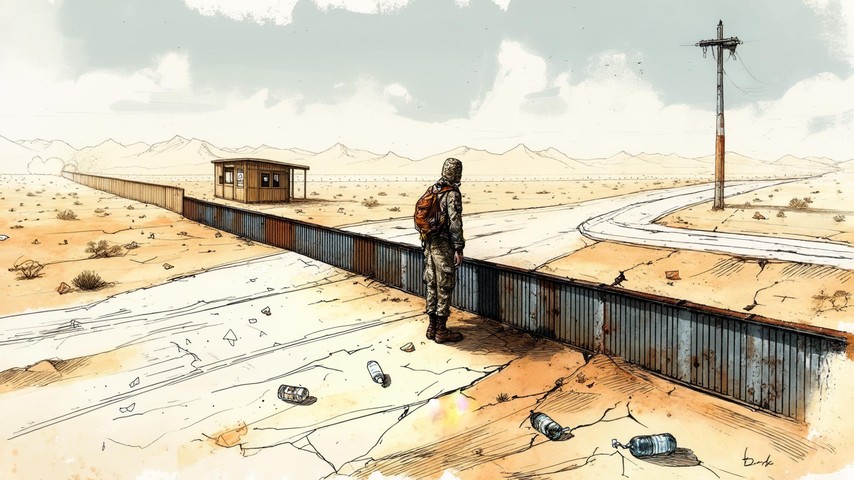
The Supreme Court will hear oral arguments next week in a major immigration case concerning the rights of asylum seekers at the U.S.-Mexico border. The dispute in Noem v. Al Otro Lado centers on whether federal immigration law protects noncitizens who are turned away at ports of entry before physically entering American soil.
The 'Metering' Policy
The case challenges a practice known as "metering," which began nearly a decade ago. Under this policy, Customs and Border Protection officials stationed along the border turned back asylum seekers and other noncitizens lacking valid travel documents before they could cross into the United States. What started as a response to Haitian immigrants in San Diego expanded nationwide by 2017 and was formalized through official memoranda in 2018.
Though the Department of Homeland Security rescinded these memoranda over four years ago, the Trump administration maintains that metering remains a "critical tool" for managing border surges and preventing overcrowding at official entry points.
The Legal Dispute
Federal immigration law allows noncitizens to apply for asylum when they are "physically present in the United States" or when they "arrive in the United States." The central question is whether someone standing at a port of entry—on the Mexican side of the border—has "arrived in" the United States.
In 2024, a divided panel of the U.S. Court of Appeals for the 9th Circuit ruled in favor of the asylum seekers. Judge Michelle Friedland wrote that "arrives in the United States" covers those who encounter officials at the border, regardless of which side they stand on. Judge Daniel Bress dissented, joined by 11 colleagues, arguing that this interpretation violates clear statutory text and the presumption against applying U.S. law extraterritorially.
The Arguments
Government Position
The government presents three main arguments:
- 📋 Statutory text: In ordinary English, one "arrives in" a country only by crossing its borders. The 9th Circuit effectively rewrote the law.
- ⚖️ Precedent: The 1993 decision in Sale v. Haitian Centers Council held that immigration laws do not protect refugees intercepted at sea before reaching U.S. territory. The same logic should apply to land borders.
- 🌍 Extraterritoriality: The presumption that federal law applies only within the United States would be violated by extending asylum protections to people in Mexico.
Challengers' Position
The immigrant rights group and asylum seekers counter that:
- 📝 Grammar matters: Congress used the present tense "arrives," indicating ongoing action rather than completed arrival. The government's reading would render "physically present" superfluous.
- 📜 Regulatory history: Since 1997, regulations have treated those "attempting to come into the United States at a port-of-entry" as "arriving." This reflects practice dating to 1917.
- 🌐 International law: The government's interpretation risks violating the principle of non-refoulement—sending refugees back to persecution.
- 🚶 Perverse incentives: Turning away people at official crossings encourages dangerous crossings between ports of entry, the exact outcome Congress sought to prevent.
What's at Stake
The challengers emphasize that their victory below does not eliminate border management tools—it merely requires allowing asylum applications at ports of entry. Reasonable processing delays remain permissible. They argue that if the executive branch wants different rules, it should seek legislation from Congress rather than judicial reinterpretation.
The administration warns that affirming the 9th Circuit would strip away essential authority for handling immigration surges, with bipartisan officials opposing the lower court's ruling.
"Created a humanitarian crisis in Mexico" — how challengers described the metering policy's real-world impact